/132.4384089,34.4201433,9/397x132?access_token=pk.eyJ1IjoiamFwYW50cmF2ZWxtYXBzIiwiYSI6ImNqbXBtOXYxbDB5Z3ozbHFrazJuYWMwOGYifQ.v15fy_mcFWtgopmz8PhwqA)

Hébergements
L'Auberge J-Hoppers à Hiroshima
Geraldine BartoliJ-Hoppers, l’une des auberges de jeunesse les moins chères et les plus agréables que vous puissiez trouver à Hiroshima !


Mitaki-dera is a beautiful traditional Japanese temple complex, tucked away in a forest on the slopes of Mount Mitaki, just north of the city of Hiroshima. Mitaki is named for the three waterfalls on its site, as its Japanese characters literally" "three" "and "" Waterfall "" read.
The temple is dedicated to Kannon, the goddess of mercy and was built in 809. There is a distinctive two-story pagoda near the entrance to the complex. It was moved from Wakayama to Hiroshima in 1951 to comfort the souls of those killed by the atomic bomb.
There are several memorials for the atomic bomb victims and also numerous stone Jizo statues. Jizo is the protector of women, children, and travelers, and his statues can often be recognized by their bright red hats and bibs. There is also a small, rustic looking tea house that serves traditional Japanese food.
J-Hoppers, l’une des auberges de jeunesse les moins chères et les plus agréables que vous puissiez trouver à Hiroshima !
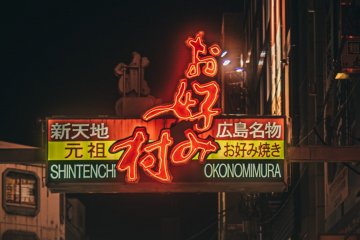
Okonomimura est un parc à thème gastronomique dédié aux okonomiyaki d'Hiroshima, plat très répandu au Japon et situé près de l'extrémité est de la rue commerçante Hondōri à Hiroshima. On y trouve 24 restaurants d'okonomiyaki, chacun avec un style et une sélection d'ingrédients légèrement différents L'okonomiyaki est proche du "Issen Yoshoku" ("repas occidental à un centime"), un plat populaire auprès des gens ordinaires pendant l'ère d'avant-guerre. Il se composait d'une pâte de farine cuite avec des oignons, des crevettes séchées et des épices. Après la guerre, d'autres ingrédients tels que le chou, les œufs, les fruits de mer, le sarrasin et les nouilles de blé ont été utilisés pour améliorer l'alimentation en ces temps difficiles. C'est ainsi qu'est né l'okonomiyaki dans la ville d’Hiroshima. [Photo: Victor Lee / CC BY-NC-ND 2.0]
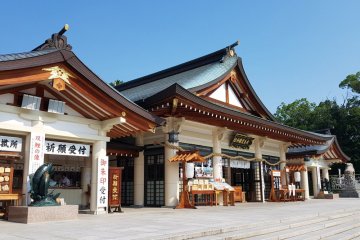
Located on the grounds of Hiroshima Castle, Hiroshima Gokoku Jinja (広島護国神社) is a Japanese Shinto Shrine in central Hiroshima City. "Gokoku" Shrines are Shinto shrines designated as places of worship for those who have died in war. Like the controversial Yasukuni Shrine in Tokyo, what became Hiroshima's Gokoku Shrine was also originally constructed in 1868 to commemorate the Hiroshima Han victims of the Boshin War. Seventy-eight souls were enshrined in the Futabanosato shrine, named Mikureisha (水草霊社). Eventually, the total number of souls enshrined there reached 92,700, including the soldiers from the former Aki no kuni (now western Hiroshima Prefecture) who died in Japan's wars up until the start of the Great East Asian War (as World War 2 post Pearl Harbor is known in Japan) and around 10,000 workers and volunteer corps who were stationed in Hiroshima and lost their lives to the A-Bomb. In 1934 it was dismantled, rebuilt and renamed Kansaishoukonsha (官祭商塊社), and moved to a corner of the west of the military parade ground, where the Hiroshima Municipal Baseball Stadium stood until the end of 2008. In 1939, its name was changed by order of the Interior Ministry to the Hiroshima Gokokujinja. In 1945 it was destroyed by the atomic bomb, and was rebuilt on the current site within the grounds of Hiroshima Castle in 1956 with the aid of donations from the citizens of Hiroshima. The current main building is even more recent, rebuilt in 1995, when the grand stone slab approach was also added. Events at the shrine are held throughout the year.
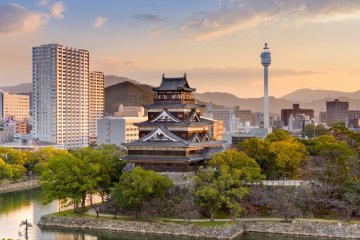
Le château d'Hiroshima (広 島 城), également connu sous le nom de château de la Carpe, a été construit à l'origine en 1589. Il a été détruit par la bombe atomique avec le reste de la ville en 1945 et a été reconstruit en 1958. Depuis lors, il a également servi de musée pour l'histoire d'Hiroshima avant la Seconde Guerre mondiale. L'histoire du château lui-même, ainsi que des châteaux japonais en général, est relatée de façon intéressante. Le château d'Hiroshima est un bon exemple de château construit sur une plaine au centre d'une ville, par opposition aux châteaux sur les collines et les sommets des montagnes. Sa tour principale est haute de cinq étages et son parc est entouré d'un fossé. Dans le parc du château, on trouve également un sanctuaire, des ruines et des bâtiments Ninomaru reconstruits (deuxième cercle de défense).

The Atomic Bomb Dome, or Gembaku Dome, was once the Hiroshima Prefectural Industrial Promotion Hall. On August 6th, 1945, the world’s first atomic bomb exploded in the air directly over the building. The Hiroshima Prefectural Industrial Promotional Hall was initially built in 1915. Designed by Czech architect Jan Letzel, the building featured European construction styles and was considered both a picturesque and important site in Hiroshima city. When the atomic bomb exploded directly overhead at 8:15am on August 6th, the resulting nuclear blast killed everyone within the building itself and in the immediate vicinity. The roof was set ablaze and the walls were destroyed but the metal frame of the building was mostly left intact. In the post-war years, the hall became known colloquially as the Atomic Dome. Several renovations have been carried out on the remains over the decades, mostly to counteract severe weathering. In 1996, the dome was registered as a UNESCO World Heritage Site. Today, the A-Bomb Dome sits at the northern end of the Hiroshima Peace Memorial Park, a short walk from the Gembaku Dome tram stop (Gembaku-mae) and the city’s central shopping arcades. In the evening, muted lighting illuminates the dome. It presents a striking scene of sadness and loss but also perseverance and hope.